Every year on 2 October, India observes Gandhi Jayanti — the birth anniversary of Mohandas Karamchand Gandhi, the man most responsible for shaping India’s non-violent freedom movement and the principles the country’s democracy still claims to stand on. It is one of only three national festivals in India (along with Republic Day and Independence Day) and is also recognized globally as the International Day of Non-Violence by the United Nations.
Gandhi Jayanti 2026 arrives at a moment when its central idea — the right to protest peacefully against those in power — is itself making headlines. This year, the day coincides with a planned nationwide protest against the Chief Election Commissioner, a story that has pulled Gandhi’s name and his methods directly into the current news cycle. This article covers both sides of that: who Gandhi was and what the day means, and why 2 October 2026 specifically is in the news.
When is Gandhi Jayanti 2026?
Gandhi Jayanti 2026 falls on Friday, 2 October 2026. It is a gazetted national holiday, meaning government offices, schools, banks and most businesses across India remain closed.
Who Was Mahatma Gandhi?
Mohandas Karamchand Gandhi was born on 2 October 1869 in Porbandar, in present-day Gujarat. Trained as a barrister in London, he first developed his methods of non-violent resistance while fighting discrimination against the Indian community in South Africa, before returning to India in 1915 to lead the independence movement against British colonial rule.
Gandhi’s approach rested on a small number of core ideas that he returned to again and again:
- Satyagraha – literally “holding firmly to truth,” Gandhi’s term for non-violent civil resistance, used to pressure unjust laws and authorities without resorting to violence.
- Ahinsa – non-violence, not just as a tactic but as a moral principle that applied to thought, word and action.
- Swaraj – self-rule, both in the political sense of Indian independence and in the personal sense of self-discipline.
- Civil disobedience – the deliberate, open and peaceful breaking of specific unjust laws, followed by willingly accepting arrest, so as to draw moral and public attention to an injustice.
These ideas were not abstract philosophy for Gandhi — he built entire movements around them, from the Salt March of 1930 to the Quit India Movement of 1942. Among his tactics was the “Jail Bharo Andolan,” or “fill the jails” movement, where volunteers deliberately courted arrest in large numbers to overwhelm the colonial justice system and demonstrate mass support for a cause. The tactic resurfaces periodically in Indian protest movements even today — including, as it happens, in a protest planned for this very Gandhi Jayanti.
Gandhi was assassinated on 30 January 1948, less than six months after independence, by a Hindu nationalist who opposed his views on religious tolerance. His death is separately observed every year on 30 January as Martyrs’ Day.
Why Gandhi Jayanti Matters
Gandhi Jayanti is not just a holiday marking a birth date — it is India’s annual occasion to revisit the values Gandhi stood for: truth, non-violence, religious harmony, simplicity, and accountability of the powerful to the people. Government campaigns like Swachh Bharat Abhiyan (the Clean India Mission) deliberately launched on 2 October 2014, tying Gandhi’s emphasis on cleanliness and self-reliant villages to a modern public health drive. Schools hold essay competitions and prabhat pheris (early morning peace processions); Raj Ghat in Delhi, where Gandhi was cremated, sees prayer meetings and tributes from political leaders across party lines; and spinning the charkha (spinning wheel), a symbol Gandhi used to promote self-reliance, remains a common classroom activity on this day.
Gandhi Jayanti 2026: Why This Year’s October 2 Is Different
This year, Gandhi Jayanti has taken on an unusually sharp political edge because of a protest planned for the same day in Mumbai.
The Cockroach Janta Party (CJP), led by its founder Abhijeet Dipke, has been demanding the resignation of India’s Chief Election Commissioner, Gyanesh Kumar, accusing him of failing to run the Election Commission of India (ECI) impartially. The demand follows months of controversy around the Special Intensive Revision (SIR) of electoral rolls, a nationwide exercise that began in October 2025 and led to large numbers of voters being removed from the rolls in several states — reportedly around 91 lakh names in West Bengal and over 2 crore in Uttar Pradesh. Opposition parties, including the Congress, have criticised the exercise as opaque and have separately called for Kumar’s resignation, with reports of protest slogans like “Vote Chor” (“vote thief”) appearing outside his residence. The Election Commission, for its part, has defended the SIR process and said it has taken steps to assist voters affected by the revision.
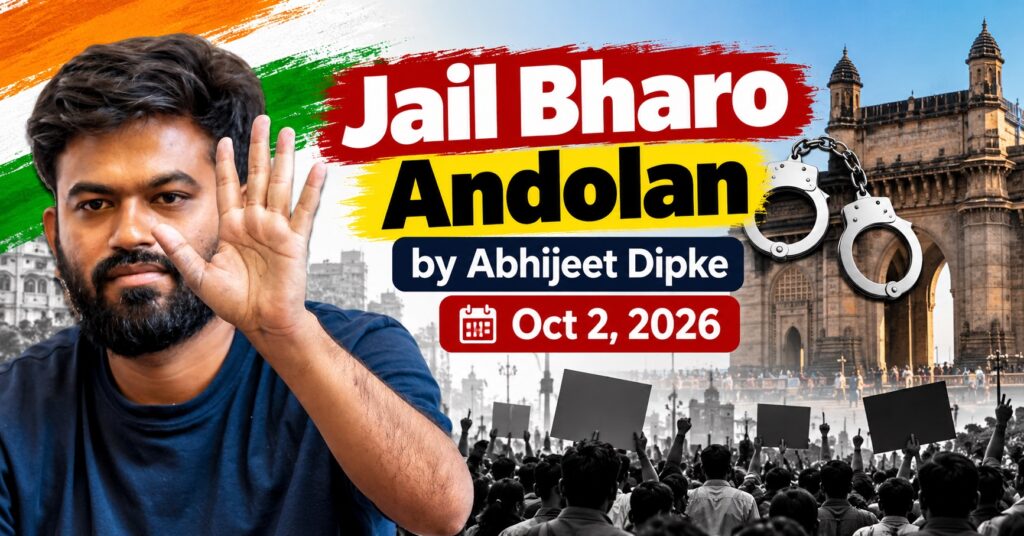
Against this backdrop, CJP set a deadline of 26 September 2026 for Kumar to resign. When he did not, the party announced it would hold a protest at Shivaji Park in Mumbai. According to Dipke’s statements on social media, Mumbai Police denied the group permission to hold the demonstration. In response, CJP announced it would instead launch a “Jail Bharo Andolan” — deliberately courting arrest in large numbers — starting on 2 October, Gandhi Jayanti, with plans to extend the movement to other cities afterward. The party has listed three central demands: Kumar’s resignation and the start of criminal proceedings against him, a freeze on the SIR process, and reforms to how the Election Commission is constituted and run.
The protest has drawn some notable voices. Ladakh-based climate and education activist Sonam Wangchuk publicly backed the broader push for “electoral accountability” on 28 September, calling October 2 “a very sacred day” because of its connection to Gandhi and his belief in peaceful protest as a tool for change — while indicating he might not attend the Mumbai demonstration in person. Separately, CJP has alleged that one of its co-convenors and around 40 volunteers were detained by police in Guwahati, Assam, ahead of an unrelated party meeting, which the group has cited as part of a pattern of pressure against it.
It’s worth being clear about what is established fact here and what is allegation. That CJP exists, that it has demanded Kumar’s resignation, that Mumbai Police denied permission for the Shivaji Park protest, and that CJP announced a Jail Bharo Andolan from 2 October are all matters of public record reported across multiple outlets. The claims that Kumar has acted improperly, or that the SIR process was intentionally skewed, remain contested political allegations — denied or disputed by the Election Commission and not something that has been independently adjudicated. Readers following this story should treat the resignation demand and the underlying accusations as an ongoing, evolving political dispute rather than a settled matter.
If Gandhi Were Alive Today: A Reflection
It’s tempting, especially on Gandhi Jayanti, to ask what Gandhi would make of a protest like this one — but it’s worth being honest about the limits of that question. Gandhi died in 1948, decades before India’s current Election Commission structure, the SIR process, or modern digital-age politics existed. Nobody can say with certainty how he would have judged a specific, contested dispute like this one, and it would be unfair to either side to claim his endorsement.
What can be said, based on what he actually wrote and did, is which principles he was consistent about:
- He defended the right to peaceful protest as fundamental, even against laws and authorities he believed were acting in good faith, as long as the protest itself remained non-violent and dissenters were willing to accept the legal consequences of civil disobedience.
- He was deeply suspicious of any single institution or individual accumulating unchecked power, and consistently argued that those in positions of public authority were accountable to the people they served, not the other way around.
- He insisted that the integrity of the method mattered as much as the cause — he repeatedly called off even successful movements, including the non-cooperation movement in 1922, when they turned violent, because for him the means could not be separated from the ends.
- He valued free and fair participation in self-governance extremely highly, since the entire independence movement was built on the idea that Indians, not a distant authority, should decide India’s own affairs.
So rather than claiming Gandhi would have taken a side in the Gyanesh Kumar controversy specifically, it’s more accurate to say that the tactic being used — a Jail Bharo Andolan, deliberately courting arrest to make a peaceful point — is drawn directly from his own playbook, and that the broader question being raised, about accountability of those who run India’s elections, touches on values he spoke about often. Whether any particular set of allegations in 2026 is justified is for courts, the Election Commission and voters to judge, not something that can be settled by invoking a man who died 78 years ago.
How Gandhi Jayanti Is Usually Celebrated
Beyond this year’s news, Gandhi Jayanti follows a fairly consistent pattern across India every year:
- Raj Ghat, Delhi – the President, Prime Minister and other leaders pay floral tributes at Gandhi’s memorial, usually alongside devotional bhajans, including his favourite, “Raghupati Raghav Raja Ram.”
- Schools and colleges – essay and speech competitions on Gandhi’s life, skits re-enacting episodes from the freedom struggle, and khadi/charkha demonstrations.
- Prabhat pheris – early morning peace marches in cities and towns, often with participants singing patriotic and devotional songs.
- Dry day – the sale of alcohol is banned on Gandhi Jayanti across India, in line with Gandhi’s own strong views on temperance.
- Government campaigns – the Swachh Bharat Abhiyan traditionally sees renewed cleanliness drives on this date, including participation from public figures and government departments.
The History of “Jail Bharo Andolan” as a Protest Tactic
Since this year’s Gandhi Jayanti is tied to a Jail Bharo Andolan, it’s worth understanding where the tactic actually comes from. Gandhi used mass, voluntary arrest as a strategy throughout the independence movement — the idea was simple: if enough people deliberately broke an unjust law and accepted imprisonment without resistance, the colonial government would either have to fill every jail in the country or back down, and either outcome exposed the injustice of the law to the wider public and the world.
The tactic didn’t disappear after independence. It has been revived periodically by movements across the political spectrum whenever a group wanted to signal that its protest was peaceful, disciplined and rooted in the same moral tradition as the freedom struggle. Anna Hazare’s anti-corruption movement used the language of Jail Bharo Andolan around the Jan Lokpal Bill in 2011, and various parties — including, at different points in history, both ruling and opposition parties — have launched their own versions of the tactic against price rises, land acquisition, and other grievances. The common thread is always the same: courting arrest peacefully, rather than resisting it, is meant to be the point.
That history is exactly why choosing 2 October for this year’s protest is unlikely to be a coincidence. Framing a demonstration as a Jail Bharo Andolan on Gandhi’s birthday is a deliberate attempt to borrow the moral weight of his legacy and method, regardless of which side of the current dispute one finds more convincing.
Gandhi’s Teachings That Still Come Up Every Year
A few of Gandhi’s ideas resurface in Indian public conversation so often that they’re worth spelling out on their own:
- “Be the change you wish to see” — often paraphrased from his broader writings, this captures his belief that personal conduct and political demands had to match each other; he was uncomfortable with movements that demanded integrity from the state while ignoring it in their own ranks.
- Trusteeship — Gandhi’s idea that the wealthy and powerful should see themselves as trustees of their resources for the benefit of society, not owners in an absolute sense, a concept still invoked in debates about corporate responsibility and inequality.
- Decentralisation and Gram Swaraj — his preference for self-governing villages over concentrated central power, which continues to influence debates about panchayati raj and local self-government in India.
- Interfaith respect — Gandhi’s insistence that India’s strength lay in its religious plurality, a position that ultimately cost him his life and remains a reference point in discussions about communal harmony.
Gandhi Jayanti vs Other National Festivals
India has only three national festivals, and Gandhi Jayanti is distinct from the other two in one important way: Republic Day (26 January) and Independence Day (15 August) both commemorate constitutional and political milestones, while Gandhi Jayanti commemorates a person — specifically, a person whose core message was about means, methods and conscience rather than any single political outcome. That’s part of why the date keeps resurfacing in connection with protest movements across Indian history, from Gandhi’s own lifetime to this year’s CJP demonstration: 2 October has become the default symbolic date for any movement that wants to frame itself as peaceful, moral and in the spirit of civil disobedience.
Frequently Asked Questions
Is Gandhi Jayanti a national holiday? Yes. It is a gazetted public holiday across India, and banks, schools, and government offices remain closed.
Why is alcohol sale banned on Gandhi Jayanti? Gandhi was a strong advocate of temperance and personal discipline, and the “dry day” tradition on his birth anniversary reflects that part of his legacy.
What is the UN’s International Day of Non-Violence? In 2007, the United Nations General Assembly designated 2 October, Gandhi’s birthday, as the International Day of Non-Violence, to globally promote his philosophy of peaceful resistance.
What is a “Jail Bharo Andolan”? It’s a protest tactic, originally used extensively during India’s freedom struggle, where large numbers of volunteers deliberately break a law and court arrest to overwhelm the system and draw attention to a cause. It has been revived by several movements since independence, including the one planned for this Gandhi Jayanti.
Who is Gyanesh Kumar? Gyanesh Kumar is the current Chief Election Commissioner of India, who has faced calls for resignation from the Cockroach Janta Party and some opposition leaders over the Special Intensive Revision of electoral rolls — a dispute that remains contested and unresolved as of this writing.
The Bigger Picture
Gandhi Jayanti 2026 is, at its core, still what it has always been — a day to reflect on non-violence, truth and the idea that political power exists to serve people rather than the other way around. That this year’s 2 October also carries a live political controversy, with a protest movement explicitly invoking Gandhi’s own tactics against the sitting Chief Election Commissioner, is a reminder of how durable his methods remain in Indian public life, even eight decades after his death. Whatever one’s view on the specific allegations around Gyanesh Kumar and the SIR process, the fact that both sides of India’s political spectrum still reach for Gandhi’s language and symbolism every 2 October says something about how central he remains to the country’s idea of itself.