India is often called the land of festivals, and 2026 is no different. From the winter harvest of Lohri in January to the lights of Diwali in November, almost every month of the year brings a new celebration somewhere in the country.
Whether you are looking for the Indian festivals list 2026, want to know all indian festivals dates in one place, or are simply curious about the festivals of India, this page gives you the complete, up-to-date picture — a full calendar, month-by-month breakdown, and details of national, religious and regional festivals celebrated across India.
India’s festival calendar is unique because it blends multiple systems together. National festivals like Republic Day and Independence Day follow the fixed Gregorian calendar, while most Hindu, Muslim, Sikh, Buddhist and Jain festivals follow lunar or lunisolar calendars, which is why their dates shift every year. This is also why searches for “indian festivals 2026” spike so sharply compared to previous years — people want the current year’s exact dates, not last year’s.
Complete List of Indian Festivals 2026 (Date-Wise)
Here is the full indian festivals calendar 2026 list, arranged by date. Dates for Islamic festivals (marked with *) depend on the sighting of the moon and may shift by a day.
| Date | Festival |
|---|---|
| 13 January | Lohri |
| 14 January | Makar Sankranti / Pongal |
| 23 January | Vasant Panchami |
| 26 January | Republic Day |
| 15 February | Maha Shivratri |
| 3 March | Holika Dahan |
| 4 March | Holi |
| 19 March | Ugadi / Gudi Padwa / Chaitra Navratri Begins |
| 20–21 March | Eid-ul-Fitr* |
| 26 March | Ram Navami |
| 31 March | Mahavir Jayanti |
| 2 April | Hanuman Jayanti |
| 3 April | Good Friday |
| 14 April | Baisakhi / Ambedkar Jayanti |
| 20 April | Akshaya Tritiya |
| 1 May | Buddha Purnima |
| 27–28 May | Eid-ul-Adha (Bakrid)* |
| 26 June | Muharram* |
| 29 July | Guru Purnima |
| 15 August | Independence Day |
| 26 August | Onam (Thiruvonam) |
| 28 August | Raksha Bandhan |
| 4 September | Krishna Janmashtami |
| 14 September | Ganesh Chaturthi |
| 2 October | Gandhi Jayanti |
| 11 October | Sharadiya Navratri Begins |
| 20 October | Dussehra (Vijayadashami) |
| 29 October | Karva Chauth |
| 6 November | Dhanteras |
| 8 November | Diwali |
| 10 November | Govardhan Puja |
| 11 November | Bhai Dooj |
| 15 November | Chhath Puja |
| 24 November | Guru Nanak Jayanti |
| 25 December | Christmas |
This table covers the major indian festivals list, but India also observes hundreds of smaller, region-specific festivals throughout the year — from Bihu in Assam to Vishu in Kerala.
How Are Indian Festival Dates Decided?
One of the most common questions people have is why Indian festival dates change every year instead of staying fixed like Christmas or New Year. The answer lies in the calendars India follows:
- Gregorian (solar) calendar – used for national festivals like Republic Day, Independence Day, Gandhi Jayanti and Christmas, which always fall on the same date.
- Hindu lunisolar calendar – used for most Hindu festivals like Diwali, Holi and Navratri. This calendar is based on the positions of the moon and sun together, which is why festival dates shift by 10–15 days each year on the Gregorian calendar.
- Islamic (Hijri) lunar calendar – used for Eid-ul-Fitr, Eid-ul-Adha and Muharram. Since this calendar is purely lunar and about 11 days shorter than the solar year, Islamic festivals move backward through the seasons over time, and exact dates depend on the physical sighting of the moon.
This is exactly why “indian festivals 2026” and “indian festivals list 2026” see such a massive spike in searches every single year — the dates genuinely are different from the year before, so last year’s list doesn’t work anymore.
Indian Festivals Calendar 2026
Prefer to see festivals on a calendar view instead of a table? Use the interactive calendar below to check any date and see which festivals fall on it in 2026.
Please note that 'G' (●) designates Gazetted and 'R' (●) designates Restricted Holidays[cite: 6, 7].
Month-Wise Indian Festivals 2026
If you’re searching for festivals in a specific month, here is a quick month-wise breakdown for the full year.
Indian Festivals in January
January opens the festival calendar with Lohri (13 January), a Punjabi harvest festival marked by bonfires and folk songs, followed closely by Makar Sankranti and Pongal (14 January), celebrated across North and South India as the sun’s transition into Capricorn. The month ends with Vasant Panchami (23 January), dedicated to Goddess Saraswati, and Republic Day (26 January), India’s national celebration of its Constitution.
Indian Festivals in February
February is relatively quiet, with Maha Shivratri (15 February) as the main event — a night of fasting and prayer dedicated to Lord Shiva, observed by millions of devotees across the country.
Indian Festivals in March
March is one of the most colourful months. Holika Dahan (3 March) and Holi (4 March) bring the festival of colours, followed by the Hindu New Year celebrations of Ugadi and Gudi Padwa (19 March) in the south and west. Eid-ul-Fitr, marking the end of Ramadan, is also expected around 20–21 March, and Ram Navami (26 March) closes out the month.
Indian Festivals in April
April brings Hanuman Jayanti (2 April), Good Friday (3 April), and Baisakhi (14 April) — the Punjabi harvest festival that also marks the Sikh New Year, celebrated the same day as Dr. Ambedkar Jayanti.
Indian Festivals in May
Buddha Purnima (1 May) is the key festival this month, commemorating the birth, enlightenment and passing of Gautama Buddha, and celebrated widely across India, Nepal and Sri Lanka.
Indian Festivals in June
June is a relatively festival-light month, with Muharram* expected around 26 June, observed by the Muslim community with mourning processions marking the martyrdom of Imam Hussain.
Indian Festivals in July
Guru Purnima (29 July) honours teachers and spiritual gurus and is one of the most widely observed days in July across Hindu, Buddhist and Jain traditions.
Indian Festivals in August
August is a festival-heavy month: Independence Day (15 August) kicks it off, followed by Onam (26 August) in Kerala and Raksha Bandhan (28 August), the festival celebrating the bond between brothers and sisters, observed across North India.
Indian Festivals in September
September brings two of the biggest Hindu festivals back to back — Krishna Janmashtami (4 September), celebrating the birth of Lord Krishna, and Ganesh Chaturthi (14 September), the ten-day celebration of Lord Ganesha that is especially grand in Maharashtra.
Indian Festivals in October
October is dominated by Navratri season. Gandhi Jayanti (2 October) opens the month, Sharadiya Navratri begins on 11 October, leading into Dussehra (20 October), and the month closes with Karva Chauth (29 October).
Indian Festivals in November
November is the biggest festival month of the year, built around Diwali. The sequence runs from Dhanteras (6 November) to Diwali itself (8 November), Govardhan Puja (10 November) and Bhai Dooj (11 November), followed by Chhath Puja (15 November) in Bihar and eastern India, and Guru Nanak Jayanti (24 November) celebrating the birth of Sikhism’s founder.
Indian Festivals in December
The year closes with Christmas (25 December), celebrated across India regardless of religion, with markets, lights and festive markets in every major city.
National Festivals of India
India officially recognises three national festivals, distinct from religious or regional celebrations because they are observed by the entire country regardless of religion:
- Republic Day (26 January) – marks the day the Constitution of India came into effect in 1950.
- Independence Day (15 August) – marks India’s freedom from British rule in 1947.
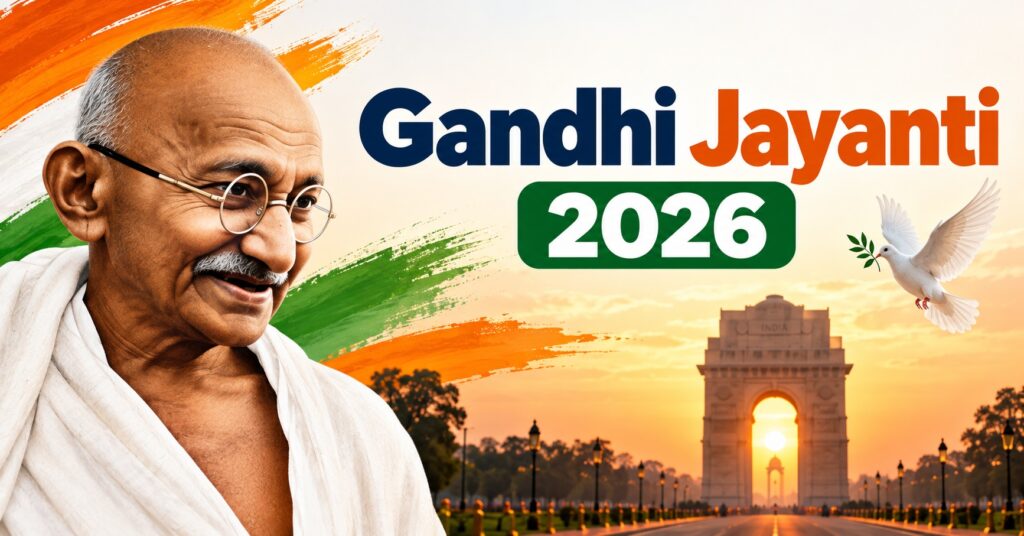
- Gandhi Jayanti (2 October) – marks the birth anniversary of Mahatma Gandhi, the Father of the Nation.
These three are gazetted national holidays and are the ones most commonly asked about under “indian national festivals” searches.
Major Hindu Festivals in India
Hindu festivals form the largest share of India’s festival calendar, since Hinduism is followed by the majority of the population. Some of the most important ones include:
- Diwali – the festival of lights, the single biggest festival in the Hindu calendar
- Holi – the festival of colours, marking the arrival of spring
- Navratri and Dussehra – nine nights of worship followed by the victory of good over evil
- Raksha Bandhan – celebrating the bond between siblings
- Janmashtami – birth of Lord Krishna
- Ganesh Chaturthi – worship of Lord Ganesha
- Maha Shivratri – dedicated to Lord Shiva
These festivals typically follow the Hindu lunisolar calendar, which is why their Gregorian dates change every year.
Muslim, Christian, Sikh, Buddhist and Jain Festivals
India’s festival calendar also reflects the country’s religious diversity:
- Muslim festivals: Eid-ul-Fitr, Eid-ul-Adha (Bakrid) and Muharram are the major Islamic observances, all based on the lunar Hijri calendar, so dates can shift by a day depending on moon sighting.
- Christian festivals: Good Friday and Christmas are the two major Christian festivals celebrated across India.
- Sikh festivals: Baisakhi and Guru Nanak Jayanti are the most significant, marking the Sikh New Year and the birth of Sikhism’s founder respectively.
- Buddhist festivals: Buddha Purnima is the most important, marking the Buddha’s birth, enlightenment and passing on a single day.
- Jain festivals: Mahavir Jayanti celebrates the birth of Lord Mahavira, the last Tirthankara of Jainism.
Regional Festivals: North India vs South India
Beyond the pan-India festivals, India’s states celebrate their own local festivals, often tied to the harvest season or regional deities.
North Indian festivals include Lohri and Baisakhi in Punjab, Karva Chauth across North India, and Chhath Puja, which is especially significant in Bihar, Jharkhand and Eastern Uttar Pradesh.
South Indian festivals include Pongal in Tamil Nadu, Onam in Kerala, Ugadi in Andhra Pradesh, Karnataka and Telangana, and Vishu, the Malayalam New Year. Many of these harvest festivals fall around the same time as their North Indian counterparts (Makar Sankranti) but are celebrated under different names and traditions.
India’s east and west also have their own signature celebrations. In East India, Durga Puja in West Bengal is arguably bigger than Navratri itself in that region, with elaborate pandals and processions, while Bihu marks the Assamese New Year and harvest season three times a year. In West India, Ganesh Chaturthi reaches its grandest scale in Maharashtra, with massive public processions before the idol immersion, and Navratri in Gujarat is celebrated through nine nights of Garba and Dandiya dance rather than just puja rituals. This regional variety is a big part of why people search separately for “north indian festivals” and “south indian festivals” — the same season can look completely different depending on which part of the country you’re in.
Indian Festivals and Culture
Festivals are one of the clearest windows into Indian culture. Each celebration carries its own food, music, dress, and rituals, passed down through generations. Diwali means new clothes, diyas and rangoli at the doorstep; Holi means colours, water balloons and gujiya sweets; Onam means the famous Onasadya feast served on a banana leaf; and Durga Puja means community pandals, dhak drums and cultural performances. Even the way a festival is celebrated can change from state to state — Makar Sankranti is about kite-flying in Gujarat, til-gud sweets in Maharashtra, and Pongal rice offerings in Tamil Nadu, all on more or less the same date. This blend of shared national occasions and locally distinct traditions is what makes the Indian festival calendar so rich, and it’s also why “festivals of india” and “indian culture” are searched together so often.
Upcoming Festivals
Want to know which festival is coming up next? Check the live list of upcoming festivals and holidays below, updated automatically.
| Date & Day | Occasion / Festival | Schools | Banks | Applicable States |
|---|---|---|---|---|
| 01 Nov 2026 (Sunday) | Kannada Rajyotsava / Haryana Day / MP Foundation Day | Closed | Closed | Karnataka, Haryana, Madhya Pradesh, Chhattisgarh, Kerala |
| 08 Nov 2026 (Sunday) | Diwali (Deepawali / Lakshmi Puja / Kali Puja) | Closed | Closed | All India |
| 09 Nov 2026 (Monday) | Govardhan Puja / Bestu Varas (Gujarati New Year) | Closed | Closed | Uttar Pradesh, Gujarat, Rajasthan, Haryana, Delhi, Madhya Pradesh, Uttarakhand, Maharashtra, Bihar |
| 10 Nov 2026 (Tuesday) | Bhai Dooj / Chitragupta Jayanti / Bhatru Dviteeya | Closed | Closed | Uttar Pradesh, Bihar, Delhi, Rajasthan, Madhya Pradesh, West Bengal, Uttarakhand, Maharashtra, Gujarat, Jharkhand |
| 15 Nov 2026 (Sunday) | Chhath Puja (Evening Arghya - Sandhya Arghya) | Closed | Closed | Bihar, Uttar Pradesh, Jharkhand, Delhi, West Bengal |
| 16 Nov 2026 (Monday) | Chhath Puja (Morning Arghya - Usha Arghya) | Closed | Closed | Bihar, Uttar Pradesh, Jharkhand, Delhi, West Bengal |
You can also check whether a specific festival or holiday falls tomorrow using our is tomorrow a holiday tool.
Frequently Asked Questions
How many festivals are celebrated in India? India celebrates hundreds of festivals through the year if regional and local celebrations are included, but around 30–35 major festivals are widely recognised nationally.
What are the 3 national festivals of India? Republic Day, Independence Day and Gandhi Jayanti are India’s three official national festivals.
Which is the biggest festival in India? Diwali is generally considered the biggest and most widely celebrated festival across India.
Why do Indian festival dates change every year? Most Hindu, Muslim, Sikh, Buddhist and Jain festivals follow lunar or lunisolar calendars rather than the fixed Gregorian calendar, so their dates shift from year to year. Only fixed-date festivals like Republic Day, Independence Day and Christmas fall on the same date every year.
Which Indian festival comes next? Use the upcoming festivals list above — it always shows the next festival based on today’s date, so you don’t have to scroll through the full calendar every time.
Are Eid-ul-Fitr and Eid-ul-Adha dates confirmed for 2026? No. Islamic festival dates depend on the physical sighting of the moon and are usually confirmed only a day or two in advance by religious authorities, so the dates listed here are best estimates and may shift by a day.
Gazetted vs Restricted Holidays
Not every festival on this list is an official day off. In India, public holidays around festivals are split into two categories:
- Gazetted holidays – compulsory holidays for all central government offices, banks and most schools, such as Republic Day, Independence Day, Diwali, Holi and Eid-ul-Fitr.
- Restricted holidays – optional holidays where employees can choose a limited number from a list each year, such as Karva Chauth, Guru Purnima or Chhath Puja in states where it isn’t a major regional festival.
This is worth knowing if you’re checking this list to plan leave from work or school, since a date being on the festival calendar doesn’t automatically mean offices will be closed — it depends on your state and organization’s holiday list.
Indian Festival Calendar Through out the Year
India’s festival calendar reflects the country’s incredible religious and cultural diversity — from national holidays observed by everyone, to Hindu festivals tied to the lunar calendar, to Islamic, Christian, Sikh, Buddhist, Jain and regional celebrations that give every state its own festive identity. Whether you’re a student trying to plan around competitive exam dates, an employee working out your leave calendar, or simply someone who loves the colour and energy of Indian festivals, this page is meant to be your one-stop reference for the full indian festivals list 2026. Bookmark it, and check back through the year as we add a dedicated, detailed post for each individual festival covering its history, rituals, regional variations and celebration ideas.